AI vs human answering service vs in‑house: which receptionist suits your garage?
Honest tradeoffs between an AI receptionist, human answering service and in‑house hire for UK garages. Costs, cover, bookings, and when to mix options.
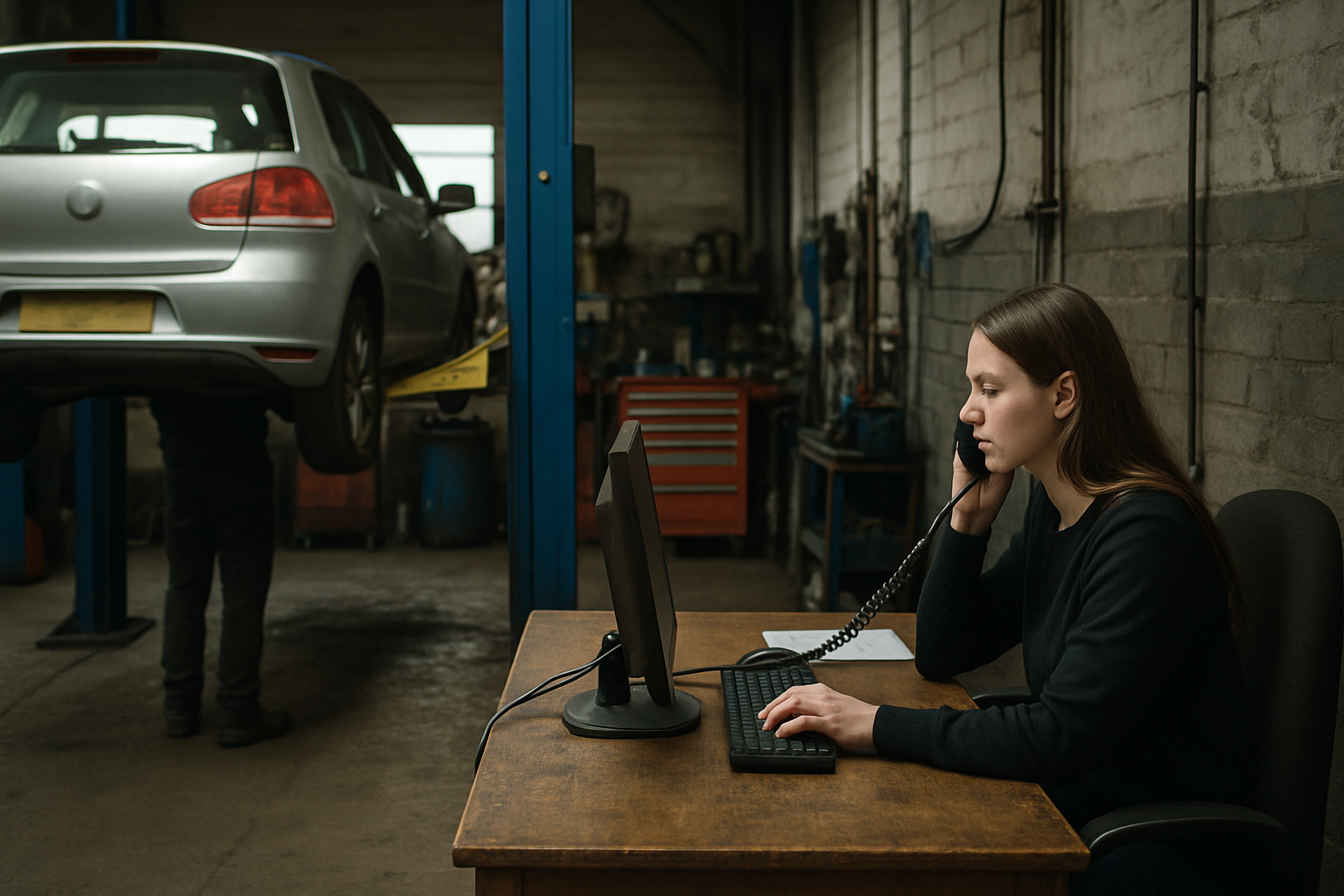
Most garages solve calls one of three ways: hire a receptionist, pay a human answering service to take overflow, or use an AI receptionist that books straight into the diary. There’s no one right answer. The best setup depends on the work you do, when your phone rings, and what “good” looks like for your front-of-house. Here’s a straight read on the tradeoffs, with examples you can map to your site.
The three options in plain terms
-
In‑house receptionist
- A person at your counter who answers calls, greets walk‑ins, takes payments, signs for parts, and chases little jobs everyone else forgets.
- Full context of your workshop, techs, parts, and promises. Can juggle priorities on the fly.
-
Human answering service
- An external call centre. They answer with your name, follow a script, and usually take messages or book basic appointments if you give them access.
- Good for overflow and out‑of‑hours. Limited workshop context. Prone to “I’ll get someone to call you back”.
-
AI receptionist
- Software that answers every call, understands intent, quotes common jobs, and books into your diary (Garage Hive, Tyresoft, etc.) if connected.
- 24/7 cover, consistent capture of reg, mileage, and notes. No small talk, and edge cases need clear hand‑offs.
Costs, cover and control
Think in three buckets: money, availability, and how much control you have over the outcome.
-
Money
- In‑house: Salary plus on‑costs. In many parts of the UK, a capable full‑time receptionist will land somewhere in the mid‑£20k–£30k salary band, before employer NI, pension, holiday cover and training. True annual cost often ends up 20–35% above headline salary.
- Human answering service: Typically per minute or per call. Packages vary widely; expect a monthly base fee plus usage. Value is strong for overflow; gets expensive if every call goes through them all day.
- AI receptionist: Subscription and/or usage based. Usually far below a full‑time hire, often competitive with or lower than answering services on a per‑call basis, especially when every call is answered, not just overflow.
-
Availability
- In‑house: Office hours only. Gaps for lunch, school runs, holidays, sickness. You’ll miss rings when the counter is busy.
- Human answering service: 24/7 options exist. Real people struggle with noisy lines and thick accents but can show empathy.
- AI receptionist: 24/7, no queue. Handles surges consistently. Background noise can lower accuracy; needs a plan to retry or escalate.
-
Control and capability
- In‑house: Maximum control. Can take payments, approve goodwill, move bookings to suit techs, and deal with trade, fleets and warranty scripts.
- Human answering service: Works to a script. Without deep system access they default to taking messages. Quality varies by agent and time of day.
- AI receptionist: Does what you configure—quotes, slots, notes—every time. Brilliant at data capture. Struggles with ambiguous or unusual requests unless you define rules and hand‑offs.
When each wins
Use cases where one option is the obvious fit.
-
Hire in‑house when:
- The counter is a hub: signing for parts, taking keys, handling payments, dealing with walk‑ins, and soothing tricky conversations.
- You run complex jobs (diagnostics, warranty, fleet approvals) where context matters and on‑the‑spot decisions are common.
- Brand feel at the front door is a priority and you want one voice customers know.
-
Use a human answering service when:
- You mainly need overflow during peaks and a friendly human “we’ll get Joe to call you back” is enough.
- Your booking system can’t be exposed externally, so message‑taking is the safest path.
- You want out‑of‑hours coverage but don’t need live booking—just capture and a morning call‑back list.
-
Use an AI receptionist when:
- Most inbound calls are bookable jobs (MOTs, tyres, interim/full services, brakes) and you want them straight in the diary with full details.
- Missed calls are a known issue during bursts and you want zero‑wait answering 24/7.
- You care about consistent data capture (reg, mileage, tyre size, warning lights) that technicians can trust.
Scenarios mapped to real garages
-
One‑to‑two‑ramp village garage
- Likely best: In‑house part‑time plus AI overflow/out‑of‑hours.
- Why: The same person greeting Mrs Jones is the one answering at 10:15. AI catches the three calls that ring during a handover and books simple work without a call‑back pile.
-
Busy five‑bay independent in a town
- Likely best: In‑house service advisor, AI as primary for first‑line calls and booking, human answering for edge cases you want a person to catch.
- Why: You keep the counter focused on face‑to‑face and workshop flow while every call gets answered. AI books the bread‑and‑butter. Human overflow handles “I need to speak to Dave about the noise since last visit.”
-
Tyre and fast‑fit centre
- Likely best: AI first, because stock/size/slots can be automated, with in‑house for walk‑ins and complex fitment questions.
- Why: Speed matters and volumes spike. AI can capture exact tyre sizes and hold a slot, reducing abandoned calls.
-
Specialist/diagnostics shop
- Likely best: In‑house as primary, AI after‑hours for intake, minimal use of answering services.
- Why: Calls are nuanced. You want a knowledgeable person triaging. AI can still collect basics out‑of‑hours so the morning call is efficient.
Hybrid setups that actually work
The most effective setups are layered. A practical stack looks like this:
-
AI as the front door, in‑house for the workshop brain
- AI answers every call. Books standard work, quotes agreed menus, and logs notes into your DMS. Anything it can’t place (warranty, trade, complaints) routes to a named inbox or warm transfer.
- Your advisor spends time on estimates, parts ETAs and customers at the desk, not on hold music.
-
In‑house first, AI for overflow and after‑hours
- Keep your receptionist. Set AI to pick up after, say, 4 rings and outside hours. It books MOTs and services rather than creating a morning chase list.
-
Answering service as the human safety net
- If you prefer a person to handle emotive cases, route “complaint” or “repeat issue” intents to the service. Keep their script tight: what to promise, what not to.
Key is clean routing: define which calls each layer owns, where bookings go, and how customers are told what happens next.
Risks, gotchas and how to test
-
Data and systems
- Only give external services the minimum access. If an AI or answering service books into Garage Hive or Tyresoft, use roles with limited permissions and an audit trail.
- Check GDPR: where is data processed, how long is it retained, and how redaction works for call recordings.
-
Payments
- Many answering services won’t take card details for compliance reasons. Most AIs shouldn’t capture card numbers at all. Keep payments in‑house or via secure links.
-
Noise and accents
- AI accuracy drops with wind, speakerphones and forecourt noise. Good systems handle repeats gracefully, but set expectations and offer SMS follow‑ups for confirmations.
-
Brand feel
- If your customers expect a familiar voice, change slowly. Start with after‑hours or specific call types before moving your main line.
-
Measure what matters
- Before/after metrics to track:
- Answer rate (aim high—missed calls should be rare).
- Time to answer (under ~15 seconds keeps callers calm).
- Bookings created per 100 calls.
- Call‑backs needed (lower is better).
- Cost per booking (all‑in, not just subscription).
- Run a 2–4 week trial. Keep your old path live, compare outcomes, and listen to a sample of calls for quality.
- Before/after metrics to track:
The right receptionist setup is the one that answers every call, books cleanly, and frees your team to run the workshop. If you want to see how an AI receptionist performs alongside your current setup, have a look at /case-studies or start a low‑risk trial at /get-started.
Découvrez ReceptionMate gérer vos appels
Réceptionniste IA conçue pour les garages — réservations directement dans votre agenda, 24h/24 et 7j/7, sans engagement.
Commencer